
Mars and the mystery of water: Scientists share new insights.
Enhanced radar has improved detection of Mars’ subsurface features.
 Seema Gupta
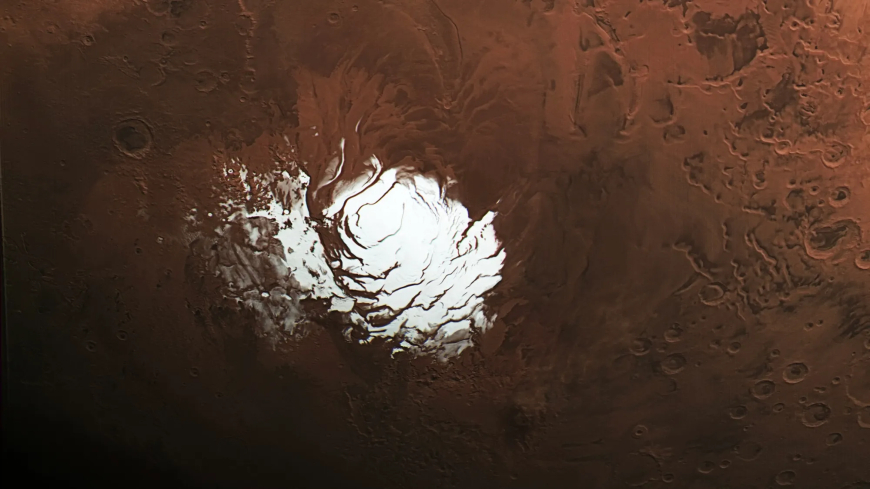
Fresh scientific answers emerge on whether Mars could truly have water. An advanced radar method has sharpened views beneath Mars’ surface.
NASA’s Mars Reconnaissance Orbiter (MRO) has taken another look at a puzzling feature hidden deep under the ice at Mars’ south pole. What was once thought to be an underground lake now appears, thanks to new radar data, to be nothing more than a mix of rock and dust.
When scientists thought they’d found a hidden lake on Mars in 2018, it sparked huge excitement—after all, water is the key ingredient for life in our solar system. Now, new evidence shows the feature isn’t a lake after all, but the radar method that revealed it could still be a powerful tool. Researchers believe it may help uncover other underground resources on Mars, paving the way for future explorers.
A study published on November 17 in Geophysical Research Letters was led by Gareth Morgan and Than Putzig, two scientists working with MRO’s Shallow Radar (SHARAD). Morgan is based at the Planetary Science Institute in Tucson, Arizona, while Putzig works from Lakewood, Colorado.
To make these observations, NASA’s Mars Reconnaissance Orbiter performed a dramatic 120‑degree roll. This maneuver boosted the strength of its SHARAD radar, allowing signals to reach deeper underground and paint a clearer picture of what lies beneath the surface. The technique—nicknamed ‘very large rolls’—has worked so well that scientists are excited to try it again at other sites where hidden ice may be waiting to be found.
Morgan, Putzig, and the SHARAD team struggled to spot the suspected buried lake until they teamed up with NASA’s Jet Propulsion Laboratory. Because MRO’s radar sits at the back of the spacecraft, its body blocked the view and weakened signals. Engineers at JPL and Lockheed Martin eventually devised a safe 120‑degree roll maneuver, letting SHARAD aim more powerfully at the surface.
Bright Signal or False Alarm?
On May 26, SHARAD pulled off a major roll maneuver and finally detected a signal in the target zone—an area stretching about 12.5 miles (20 kilometers) beneath nearly a mile (1,500 meters) of solid water ice.
When radar beams hit underground layers, the way they bounce back depends on what’s hidden below. Most materials absorb or weaken the signal, so the echo is faint. But liquid water stands out—it acts like a mirror, sending back a bright, powerful reflection, almost like shining a flashlight onto glass.
In 2018, ESA’s Mars Express orbiter picked up a signal with its MARSIS radar that looked like a hidden lake. Scientists suggested it might be briny water, since salt can keep it liquid beneath all that ice.
For nearly 20 years, SHARAD saw nothing at those depths. But after a special roll maneuver, MRO finally picked up a faint signal—unlike the bright one MARSIS had reported. Another nearby test showed no signal at all, hinting something unusual is happening at that exact spot. While the ‘lake’ idea sparked creative research, new data makes it tough to believe liquid water is really there.
Other possible interpretations
At Mars’ south pole, radar usually shows rugged terrain under the ice, but scientists think the bright signal spotted by MARSIS could simply be a rare smooth patch, like ancient lava. They’re now eager to use the ‘very large roll’ technique on other sites, including Medusae Fossae near the equator—a massive formation that may hide deep ice. If so, it could provide vital water for future astronauts in a sunnier, more livable part of Mars.